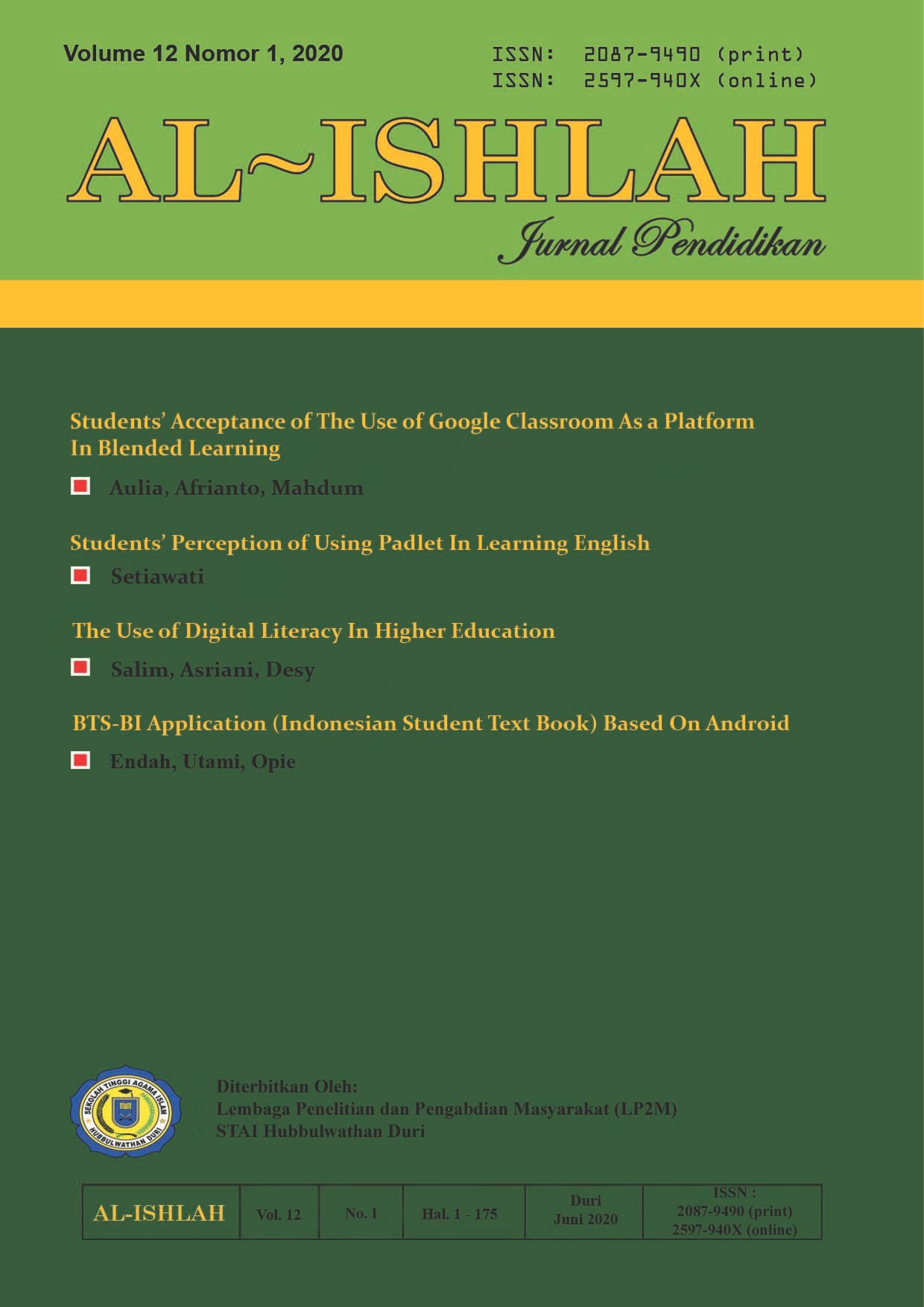
STUDENTS’ PERCEPTION OF USING PADLET IN LEARNING ENGLISH
DOI:
https://doi.org/10.35445/alishlah.v12i1.187Keywords:
Student’s Perception, PadletAbstract
This study aimed to know students’ perception of using Padlet in learning English in the first semester of Islamic Education Department STAI Hubbulwathan Duri. This research used a quantitative approach. The design of the research was a survey. In this research, the writer conducted a descriptive survey. The total population was the first semester of Islamic education STAI Hubbulwathan Duri. The undergraduate students have the same qualification and academic background before doing a survey. They had ever learned English by using Padlet. The sample of this research was 61 respondents. The total rating percentage of students’ perception using Padlet in learning English 54.5%. it was the agreed category. This category showed the respondents Agree to use Padlet application in the teaching-learning process. Based on the overall mean is 3.15 and the standard deviation is 0.673 respondents agree used it in the teaching-learning process. The respondents gave positive responses. It meant that the Padlet platform gave a positive perception to use it in the English learning process.
References
Altun, M. (2015). The Integration of Technology into Foreign Language Teaching. International Journal on New Trends in Education & their Implications (IJONTE), 6(1).
Bower. M. 2015. A typology of Web 2.0 learning technologies. EDUCAUSE Digital Library, Retrieved June 2015, from http://www.educause.edu/library/resources/typology-web-20-learning-technologies.
Boyd, D. 2007.The significance of social software. In T. N. B. J. Schmidt (Ed.), Blogtalks, Reloaded: Social Software Research & Cases. pp. 15-30. Norderstedlt: Books on Demand.
Byrne, R. (2015). Collaborative Research Tools. School Library Journal, 61(3), 16.
Cohen, lawrence, and Keith. 2007. Research Methods in Education. London and New York: Routledge.
Dörnyei, Z. 2003.Questionnaires in Second Language Research: Constructing, Administrating and processing. Lawrence Erlbaum Associates Publisher, London.
Fageeh.A.I. (2011) EFL Learners’ Use of Blogging for Developing Writing Skills and Enhancing Attitude towards English Learning: an Exploratory Study. Journal of Language and Literature, 2 (1),31-38
Fuchs, B. (2014). The Writing is on the Wall: Using Padlet for Whole-Class Engagement. LOEX Quarterly, 40(4), 7-9.
Gregoire, R., Bracewell, R., & Laferriere, T. (1996). The contribution of new technologies to learning and teaching in elementary and secondary school. Unpublished .
Kumar, Yosegh Singh. 2006. Fundamental of Research Methodology and Statistic. New Delhi : New Age International.
Kaya, H. (2015). Blending Technology with Constructivism: Implications for an ELT Classroom. Teaching English with Technology, (1), 3-13.
Shield, J. 2014.Virtual Toolkit.Screen Education 75:92-93.
Social media for teaching and learning series. www.uq.edu.au/tediteach/social-media-tools
Thomas, J.D.E.Morin, D.&Ly.S.(2014). Delivery Method and Persistence and Performance. In Proceedings of Worlds Conference on Educational Multimedia, Hypermedia and Telecommunications, Tampere, Finland, 1797-1801.
Wood, M. 2016. Padlet a graffiti wall for today‟s agricultural teacher.Agricultural Education
Downloads
Additional Files
Published
How to Cite
Issue
Section
Citation Check
License
Authors who publish with this journal agree to the following terms:
- Authors retain copyright and grant the journal right of first publication with the work simultaneously licensed under a Creative Commons Attribution License that allows others to share the work with an acknowledgement of the work's authorship and initial publication in this journal.
- Authors are able to enter into separate, additional contractual arrangements for the non-exclusive distribution of the journal's published version of the work (e.g., post it to an institutional repository or publish it in a book), with an acknowledgement of its initial publication in this journal.
- Authors are permitted and encouraged to post their work online (e.g., in institutional repositories or on their website) prior to and during the submission process, as it can lead to productive exchanges, as well as earlier and greater citation of published work.