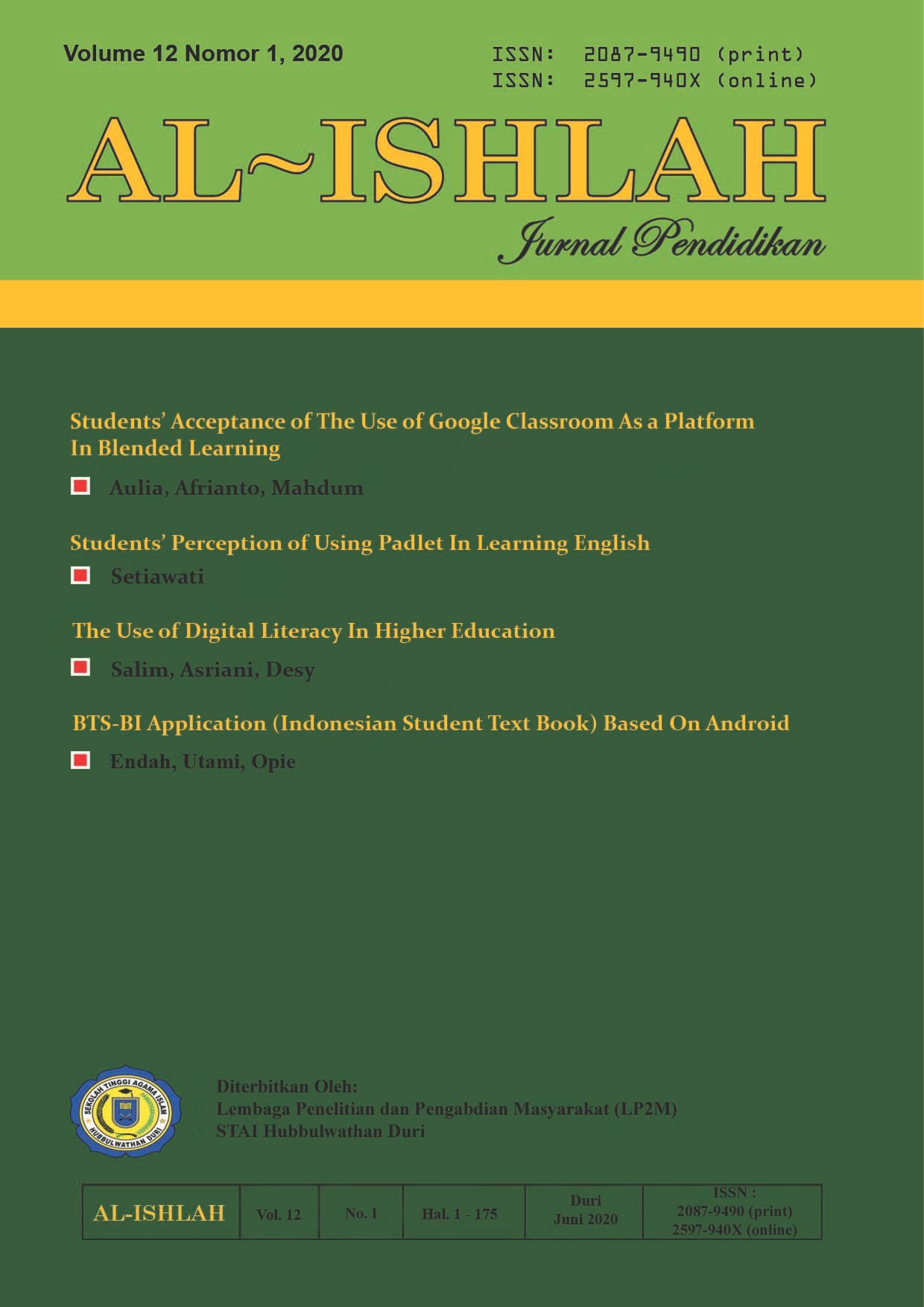
STUDENTS’ ACCEPTANCE OF THE USE OF GOOGLE CLASSROOM AS A PLATFORM IN BLENDED LEARNING
DOI:
https://doi.org/10.35445/alishlah.v12i1.193Keywords:
Acceptance, Google Classroom, Blended LearningAbstract
References
Afrianto, A. (2018). Being a Professional Teacher in the Era of Industrial Revolution 4.0: Opportunities, Challenges and Strategies for Innovative Classroom Practices. English Language Teaching and Research, 2(1).
Azhar, K. A., & Iqbal, N. (2018). Effectiveness of Google classroom: Teachers’ perceptions. Prizren Social Science Journal, 2(2), 52-66.
Clay, J. R., Teacher, M., & Elementary, P. (2019). Impact of Google Classroom on Student Engagement. The eleventh annual science of wondering, 21.
Daud, A. (2019). Teaching Writing Using Google Apps For Education (GAFE). Indonesian Journal of Economics, Social, and Humanities, 1(1), 17-24. https://doi.org/10.31258/ijesh.1.1.2.
F. D. Davis. (1986). A technology acceptance model for empirically testing new end-user information systems: Theory and results. Massachusetts Institute of Technology.
Garrison, D. R., & Kanuka, H. (2004). Blended learning: Uncovering its transformative potential in higher education. The internet and higher education, 7(2), 95-105.
Heggart, K. R., & Yoo, J. (2018). Getting the Most from Google Classroom: A Pedagogical Framework for Tertiary Educators. Australian Journal of Teacher Education, 43(3).
Jakkaew, P., & Hemrungrote, S. (2017). The use of UTAUT2 model for understanding student perceptions using Google classroom: A case study of introduction to information technology course. 2017 International Conference on Digital Arts, Media and Technology (ICDAMT), 205–209. https://doi.org/10.1109/ICDAMT.2017.7904962.
Jeya, A. K., & Brandford, B. (2019). Google Classroom for mobile learning in higher education: Modelling the initial perceptions of students. Education and Information Technologies.
Ramadhani, R., Umam, R., Abdurrahman, A., & Syazali, M. (2019). The effect of flipped-problem based learning model integrated with LMS-google classroom for senior high school students. Journal for the Education of Gifted Young Scientists, 7(2), 137-158.
Riki Rahmad, et al. (2019). Google Classroom Implementation in Indonesian Higher Education. Journal of Physics: Conference Series. 1175 012153
Sugiyono. (2009). Metode Penelitian Kuantitatif, Kualitatif dan R&D, Bandung: Alfabeta.
Wijaya, A. (2016). Analysis of factors affecting the use of Google Classroom to support lectures. In The 5th International Conference on Information Technology and Engineering Application (ICIBA2016). Bina Darma University.
Downloads
Published
How to Cite
Issue
Section
Citation Check
License
Authors who publish with this journal agree to the following terms:
- Authors retain copyright and grant the journal right of first publication with the work simultaneously licensed under a Creative Commons Attribution License that allows others to share the work with an acknowledgement of the work's authorship and initial publication in this journal.
- Authors are able to enter into separate, additional contractual arrangements for the non-exclusive distribution of the journal's published version of the work (e.g., post it to an institutional repository or publish it in a book), with an acknowledgement of its initial publication in this journal.
- Authors are permitted and encouraged to post their work online (e.g., in institutional repositories or on their website) prior to and during the submission process, as it can lead to productive exchanges, as well as earlier and greater citation of published work.