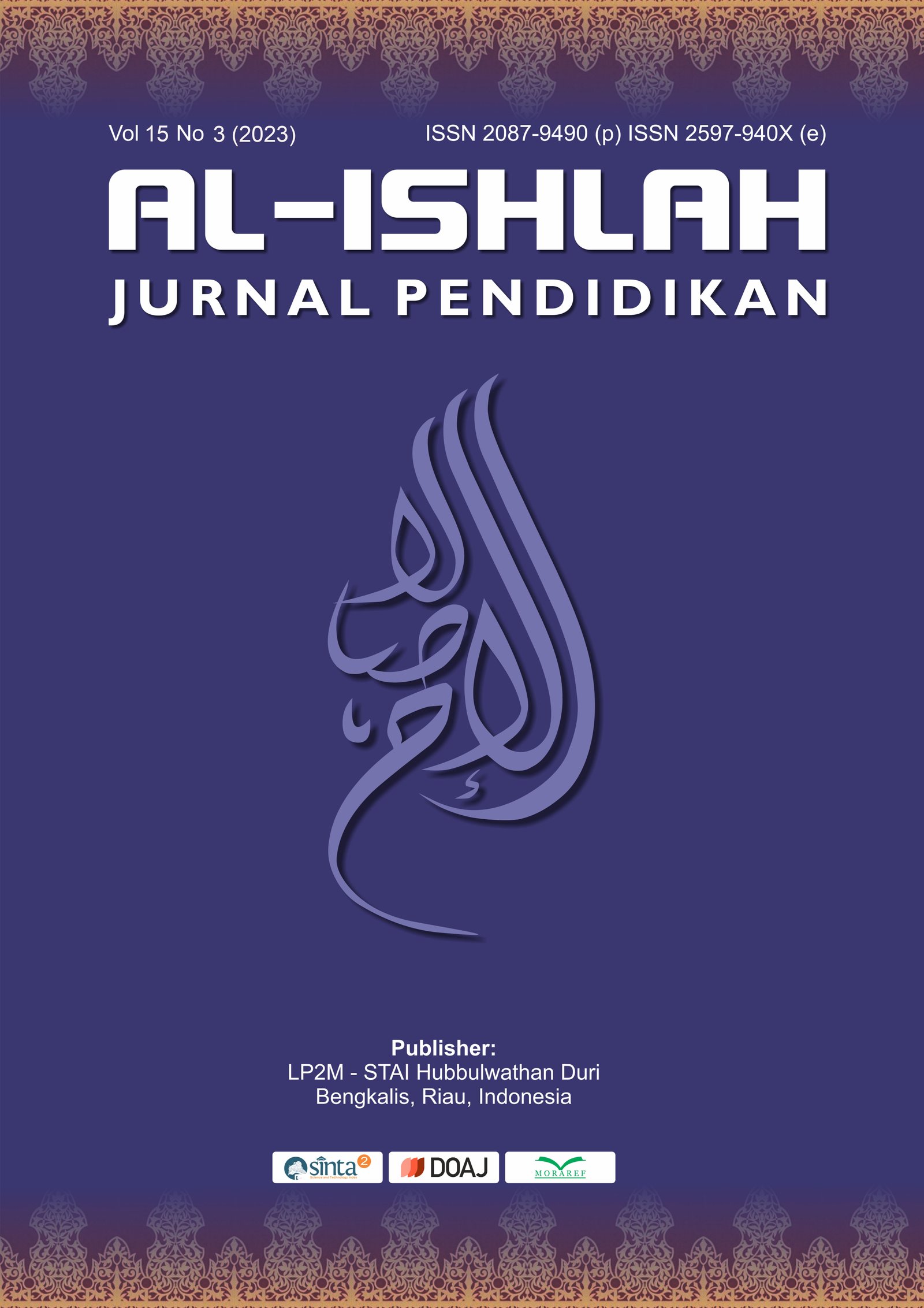
Freedom of Learning: Lesson Learned from SALAM Community
DOI:
https://doi.org/10.35445/alishlah.v15i3.3014Keywords:
Freedom of Learning, Non-formal education, Policy education, Teacher’s roleAbstract
References
Alsubaie, M. A. (2016). Teacher Involvement in Curriculum Development. Journal of Education and Practice, 7(9), 106–107.
Baro’ah, S. (2020). Kebijakan Merdeka Belajar Sebagai Peningkatan Mutu Pendidikan. Jurnal Tawadhu, 4(1), 1063–1073.
Belton, V., & Scott, J. L. (1998). Independent learning and operational research in the classroom. Journal of the Operational Research Society, 49(9), 899–910. https://doi.org/10.1057/palgrave.jors.2600593
Coskun, L. (2019). What Kind of Teacher Opens Facilitating Ways for Purposeful Learning ? What Kind of Teacher Opens Facilitating Ways for Purposeful Learning ? 18th International Conference on Social Sciences, (May). Lisbon.
Daga, A. T. (2021). Makna Merdeka Belajar dan Penguatan Peran Guru di Sekolah Dasar. Jurnal Educatio FKIP UNMA, 7(3), 1075–1090. https://doi.org/10.31949/educatio.v7i3.1279
Faiz, A., & Faridah, F. (2022). Program Guru Penggerak Sebagai Sumber Belajar. Konstruktivisme : Jurnal Pendidikan Dan Pembelajaran, 14(1), 82–88. https://doi.org/10.35457/konstruk.v14i1.1876
Indarta, Y., Jalinus, N., Waskito, W., Samala, A. D., Riyanda, A. R., & Adi, N. H. (2022). Relevansi Kurikulum Merdeka Belajar dengan Model Pembelajaran Abad 21 dalam Perkembangan Era Society 5.0. Edukatif : Jurnal Ilmu Pendidikan, 4(2), 3011–3024. https://doi.org/10.31004/edukatif.v4i2.2589
Jaghav, M. S., & Patankar, P. S. (2013). Role of Teachers’ in Curriculum Development for Teacher Education. Challenges in Teacher Education, Physical Education and Sports, (October), 1–9. Kolhapur.
Kurniawan, N. A., Saputra, R., Aiman, U., Alfaiz, A., & Sari, D. K. (2020). Urgensi Pendidikan Berpikir Kritis Era Merdeka Belajar bagi Peserta Didik. Tarbawi : Jurnal Ilmu Pendidikan, 16(1), 104–109. https://doi.org/10.32939/tarbawi.v16i01.576
Manalu, J. B., Sitohang, P., Heriwati, N., & Turnip, H. (2022). Pengembangan Perangkat Pembelajaran Kurikulum Merdeka Belajar. 1, 80–86. https://doi.org/10.34007/ppd.v1i1.174
Mazid, S., Futaqi, S., & Farikah, F. (2021). the Concept of “Freedom of Learning†in a Multicultural Education Perspective. Ta’dib, 24(1), 70. https://doi.org/10.31958/jt.v24i1.2759
Meyer, B., Haywood, N., Sachdev, D., & Faraday, S. (2008). What is independent learning and what are the benefits for students ? How is independent learning viewed by teachers ? London: Department for Children, Schools and Families Research Report, 051, 1–6.
Nasution, S. W. (2022). Assesment Kurikulum Merdeka Belajar di Sekolah Dasar. Prosding Seminar Nasional Pendidikan Dasar, 1(1), 135–142. https://doi.org/10.34007/ppd.v1i1.181
Pradewi, G. I., Wijayanti, W., & Sukowati, S. (2019). Manajemen Peserta Didik di PKBM Berbasis Alam Studi pada Sanggar Anak Alam (SALAM). Kelola: Jurnal Manajemen Pendidikan, 6(2), 193–205. https://doi.org/10.24246/j.jk.2019.v6.i2.p193-205
Salnikova, M., Salnikova, Y., Soroka, M., & Stolyarova, V. (2020). Students’ Independent Learning Activity as an Effective Method of Acquiring Professional Competencies. In Advances in Intelligent Systems and Computing (Vol. 963). Springer International Publishing. https://doi.org/10.1007/978-3-030-20135-7_39
Sherly, Edy dharma, & Humiras Betty Sihombing. (2020). Merdeka belajar: kajian literatur. UrbanGreen Conference Proceeding Library, 1, 183–190.
Talbert, T. L. (2003). Come to the Edge: Embracing Teacher Empowerment for the 21st Century. Action in Teacher Education, 25(2), 51–55. https://doi.org/10.1080/01626620.2003.10463305
Thiruvengadam, P. (2014). The Role of a Teacher in Facilitating E-Learning. Journal of Technology for ELT, 11–2(April 2012).
Wisnujati, N. (2021). Merdeka Belajar Merdeka Mengajar. Yayasan Kita Menulis.
Downloads
Published
How to Cite
Issue
Section
Citation Check
License
Authors who publish with this journal agree to the following terms:
- Authors retain copyright and grant the journal right of first publication with the work simultaneously licensed under a Creative Commons Attribution License that allows others to share the work with an acknowledgement of the work's authorship and initial publication in this journal.
- Authors are able to enter into separate, additional contractual arrangements for the non-exclusive distribution of the journal's published version of the work (e.g., post it to an institutional repository or publish it in a book), with an acknowledgement of its initial publication in this journal.
- Authors are permitted and encouraged to post their work online (e.g., in institutional repositories or on their website) prior to and during the submission process, as it can lead to productive exchanges, as well as earlier and greater citation of published work.